
Complete guide
Hair drug testing, explained
How it works, what it detects, how far back it reaches, and whether it can be cheated.
- 90+ day detection
- Court-accepted
- Chain of custody
Hair drug testing detects drugs and their metabolites inside the hair shaft. When someone consumes a drug, metabolites travel through the bloodstream and become trapped in growing hair, creating a lasting record of exposure that cannot be washed out.
- Detects use for 90 days or more
- Difficult to cheat or manipulate
- Identifies chronic or repeated use
- Accepted for legal and medico-legal purposes
Why it's accurate
- Metabolites are locked inside the hair, no washing or chemical interference reaches them.
- The window is long. Use is detectable months after ingestion.
- The instrumentation is high grade, mass spectrometry confirms very small amounts.
- It identifies patterns, segmental testing gives a month-by-month picture.
How it works, step by step
- Collection, a small sample cut from head or body; only 3–5 mm of thickness is needed.
- Chain of custody, sealed, labelled and documented to legal evidence standards.
- Laboratory analysis. The hair is washed to remove surface contamination, then the inner shaft is analysed.
- Results issued, detected metabolites, with pattern-of-use analysis where requested.
Hair shaft or hair follicle?
A common misnomer
Hair drug testing does not analyse the follicle. The test is performed on the hair shaft, not the root.
✔ Hair shaft, correct
- Holds metabolites incorporated during growth
- A stable record of exposure
- What every accredited lab tests
✖ Hair follicle, a misnomer
- Living tissue under the skin
- Not used in drug testing
- "Hair follicle test" is a widespread misunderstanding
How far back does it go?
The standard period is about 90 days, though court orders may specify otherwise. Head hair grows roughly 1 cm per month, so sample length sets the window:
- 3 cm ≈ 3 months (the standard 90-day test)
- 6 cm ≈ 6 months
- 9 cm ≈ 9 months
Measurements are taken from the root end, which is the most recent growth.
What was found is exact. When it happened is an estimate.
Which substances are in the hair, and how much of each, is measured to a very high degree of certainty. The laboratory uses mass spectrometry, which identifies a molecule by its mass rather than inferring it from a colour change or a reaction. A positive result is a positive result.
Dating that use is the approximate part. Hair does not all grow at the same speed, individual follicles grow at slightly different rates, and some are resting at any given time. It is the same reason a haircut never grows out perfectly evenly. So a length of hair corresponds to an approximate period, not to a particular day.
These are two separate questions, and this is the part worth being clear about: an estimated timeline does not make the substance finding any less reliable. The chemistry is precise. The calendar is approximate.
Longer samples can be tested, but we generally recommend stopping at about six months. Hair doesn't grow at exactly the same rate in every follicle, so the further back a segment sits, the more the dates attached to it blur.
Segmental testing. A longer sample can be split into 1 cm segments and reported month by month. This is what shows whether use has been increasing, decreasing or stable, which is often the real question in a family law matter.
Body hair. Grows more slowly and less consistently, so about three months is added to the window. A 4 cm body-hair sample represents roughly seven months.
Hair vs urine, saliva, blood and breath
Accuracy Very high · Tampering Very low
Best for: Legal, court, long-term review
Accuracy Moderate · Tampering High
Best for: Workplace screening
Accuracy Moderate · Tampering High
Best for: Roadside testing
Accuracy High · Tampering Medium
Best for: Medical settings
Accuracy High · Tampering Low
Best for: Alcohol only
| Method | Window | Accuracy | Tampering | Best for |
|---|---|---|---|---|
| Hair | 90 days+ | Very high | Very low | Legal, court, long-term review |
| Urine | 1–3 days | Moderate | High | Workplace screening |
| Saliva | 12–48 hours | Moderate | High | Roadside testing |
| Blood | Hours | High | Medium | Medical settings |
| Breath | Real time | High | Low | Alcohol only |
Can it be fooled? Myths and facts
Myth: "Washing or bleaching removes the drugs."
Fact: Labs test the inner hair shaft, which surface washing does not reach. Bleaching has a mild effect, and only where it damages the outer layer.
Myth: "Shaving your head avoids detection."
Fact: Body hair can be used instead, with a comparable, in fact longer, detection window, though a less precise timeline.
Myth: "Passive smoke causes positives."
Fact: Accredited testing looks for metabolites only produced after ingestion, at defined quantities. Low unintended exposure generally reads negative.
What your results mean
- Drug types, which substances were present.
- Concentration, the amount, in picograms per milligram (pg/mg).
- Cut-off thresholds, the minimum detection limits that decide Detected or Not Detected.
Three points that consistently cause confusion:
- "Detected" means ingestion, not surface contamination. Labs wash all samples and apply protocols to separate the two.
- It cannot determine exact dates. Growth rates vary, even on the same person.
- Segmental testing reveals patterns, where the sample is long enough to divide.
Is it accepted in court?
Yes, when performed under proper chain-of-custody procedures. Hair testing is:
- Admissible in the Family Court of Australia
- Used in child-protection matters
- Accepted for employment and workplace investigations
- Used in legal disputes involving substance misuse
Can children be tested?
Yes, in Victoria, but strict consent rules apply.
- Consent is essential, from a parent or legal guardian, from whoever holds parental responsibility (such as Child Protection under a court order), or from the young person themselves if assessed as a mature minor.
- A minor (usually 14–17) may consent where they clearly understand the purpose, risks and consequences, the mature minor test.
- Under a protection order, we confirm who legally holds parental responsibility before proceeding.
We test a minor only once consent is obtained, the young person understands the process, and the procedure is in their best interests.
Common questions
- How much hair is needed?
- About 100–150 strands, roughly 3–5 mm thick.
- Does it hurt?
- No. Hair is cut, not pulled.
- Can hair from anywhere be used?
- Head hair is preferred. Body hair works where head hair is unavailable or too short.
- How long do results take?
- Around 5–7 business days once the laboratory receives the sample.
Booking a hair drug test in Australia
In Melbourne, your hair is collected at the clinic at 4/68 Melville Road, Brunswick West VIC 3055. Anywhere else in Australia, we post a collection kit to your own GP, who collects the sample under chain of custody. A hair drug test covering 95 drugs is $699 for a 3 cm sample, about three months, and the kit is $175 on top. All fees.
The whole thing on one page
Everything above, summarised: how the hair shaft records exposure, how far back a sample reaches, what the panels cover, and how the chain of custody holds it together.
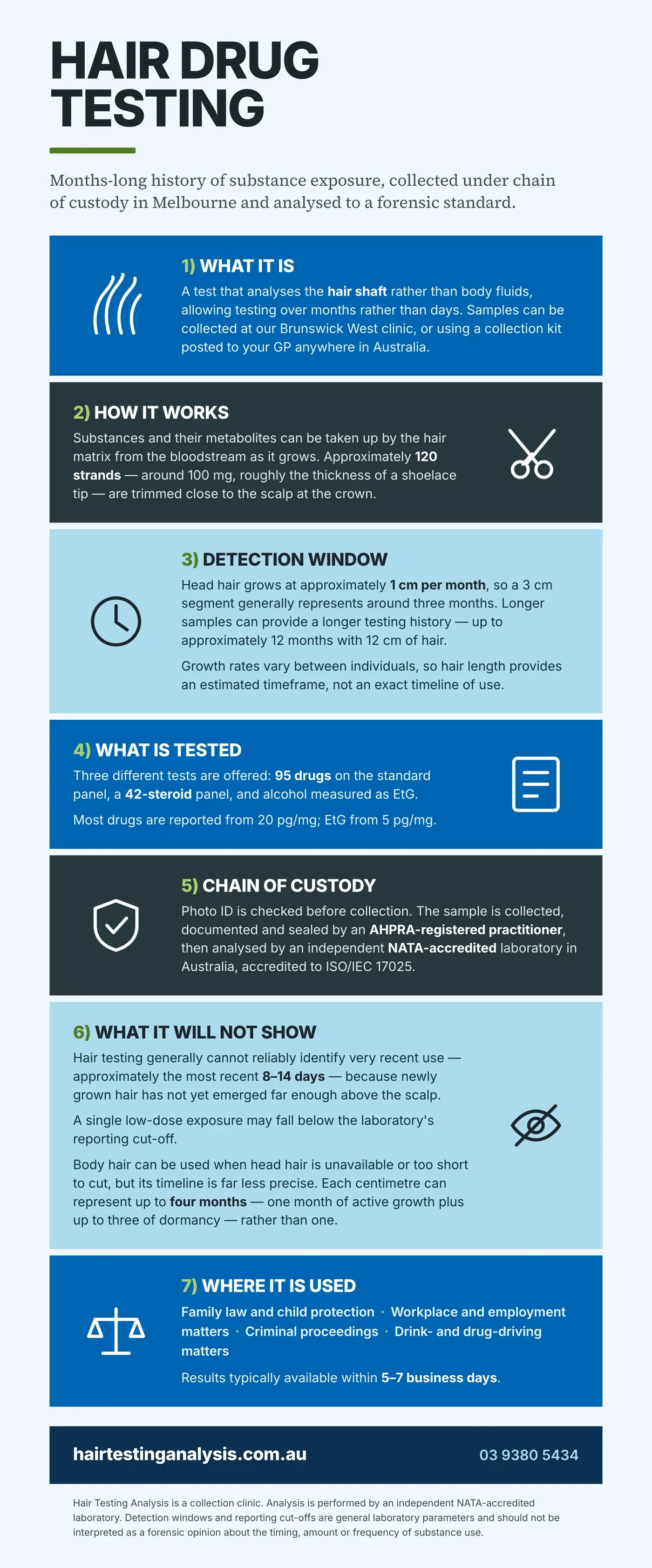
- The sample. About 120 strands, roughly 100 mg, trimmed close to the scalp at the crown.
- The reporting cut-off. Most drugs are reported from 20 pg/mg; alcohol as EtG from 5 pg/mg.
- The chain of custody. Photo ID checked before collection, then sealed and documented by an AHPRA-registered practitioner.
- The laboratory. Analysis is by an independent NATA-accredited laboratory in Australia, accredited to ISO/IEC 17025.
Book your hair drug test
Same-day appointments are usually available at our Melbourne clinic, and results are back within 5–7 business days.