

Testing information
Hair test results: the levels chart, and what pg/mg means
Cutoff levels by substance in pg/mg, set out as a chart, and the reasons a number on its own is only ever a starting point.
- Levels chart by substance
- International alcohol bands
- Limits stated plainly
What was found is exact. When it happened is an estimate.
Which substances are in the hair, and how much of each, is measured to a very high degree of certainty. The laboratory uses mass spectrometry, which identifies a molecule by its mass rather than inferring it from a colour change or a reaction. A positive result is a positive result.
Dating that use is the approximate part. Hair does not all grow at the same speed, individual follicles grow at slightly different rates, and some are resting at any given time. It is the same reason a haircut never grows out perfectly evenly. So a length of hair corresponds to an approximate period, not to a particular day.
These are two separate questions, and this is the part worth being clear about: an estimated timeline does not make the substance finding any less reliable. The chemistry is precise. The calendar is approximate.
Reading a result
A hair test result is reported in pg/mg, picograms of a substance per milligram of hair, and it measures how much was deposited into the hair shaft across the period tested. It does not convert into a dose, a number of occasions or a date, and no published method turns it into one. What 500 pg/mg means works one figure through in full.
Read this before the tables.
Sorting people into low, medium and high from a concentration alone is an estimate, not a finding. Treating it as a finding is the most common error made with these results.
What a reliable reading needs alongside the number
- Context, self-reports, medical records, prescriptions.
- Individual factors, metabolism, hair pigmentation, and cosmetic treatment such as dyeing, bleaching or straightening.
- Confirmatory testing where warranted, segmental hair analysis, or a different sample type.
Accurate interpretation needs a qualified forensic toxicologist weighing these against the specific case. Dr Michael Robertson provides written interpretation reports.
How do I convert ng to pg?
Laboratories report hair results in either picograms or nanograms per milligram of hair. The same result looks very different depending on which is used. Every figure on this page is in pg/mg.
A picogram is one thousandth of a nanogram, so the conversion is just moving the decimal point three places:
- ng to pg, multiply by 1,000
- pg to ng, divide by 1,000
The same numbers, both ways
- 0.2 ng/mg = 200 pg/mg
- 1 ng/mg = 1,000 pg/mg
- 20 pg/mg = 0.02 ng/mg
Why this matters when comparing providers. A smaller-looking number is not a more sensitive test. A cutoff advertised as 0.2 ng/mg is the same thing as 200 pg/mg, which is ten times less sensitive than a 20 pg/mg cutoff, even though "0.2" reads as the smaller figure.
The cut-offs used here
A cut-off is the level at or above which the laboratory reports a substance as detected. Most drugs begin at 20 pg/mg, with these exceptions:
- 11-nor-delta-9-tetrahydrocannabinol-9-carboxylic acid, 1 pg/mg
- Psychoactives, 2 pg/mg
- Alfentanil, Norfentanyl, Fentanyl, 2 pg/mg
- Steroids, 1 – 10 pg/mg, depending on the compound
- Alcohol (EtG), 5 pg/mg
The Psychoactives group is the NBOMe compounds, LSD and psilocin: the full list is on our drugs tested page.
A cut-off decides whether something appears on the report at all. The tables below are a separate matter. They describe how a concentration is read once it has been reported, and for most substances they begin well above these figures. A result can sit above the cut-off and still fall inside the Low band.
Why the period tested stops short of today
Hair takes time to grow through the scalp before it can be collected, so the most recently grown hair may not yet be available for testing. The testing period shown on your report does not necessarily extend right up to the date your sample was taken.
If a court or agency has named a period, tell us the dates when you book and we will work out the sample length that covers them.
Why your report mentions bleaching
The laboratory includes a statement about bleaching as a precautionary measure when chemical treatment of the hair has been disclosed. It records the treatment so that it can be considered when the results are interpreted.
It does not mean your results are unreliable. The statement itself is not a finding that bleaching affected anything. Chemical treatment such as bleaching can affect hair and is therefore taken into account during interpretation, but whether it affected a particular result is a question only a qualified forensic toxicologist can answer, on the specifics of that case.
On what the research shows about treated hair generally, see does dyeing or bleaching your hair change a drug test result?
Are drug results read the same way as the alcohol result?
No. Drug testing and EtG alcohol testing use different substances, different testing methods and different interpretation criteria, and your drug results are reported separately on the laboratory report. The tables below give the levels for each.
Can you interpret my individual result?
We can explain the testing process and the recognised reference information on this page, and reception will happily walk you through either. A formal interpretation of an individual result is a different thing: it is a forensic opinion, and it comes from a qualified forensic toxicologist.
Dr Michael Robertson does exactly that work, verbal opinions and written reports on toxicology results from any source, hair, blood, urine, saliva or breath, including results this clinic did not collect. See the expert medico-legal service.
Need the number interpreted for a court or workplace matter?
Dr Michael Robertson gives verbal opinions and written reports on results from any source, hair, blood, urine, saliva or breath, including results this clinic did not collect. Consultations start at $495, and he is instructed through the clinic. How the service works, or what a hair test costs.
Levels by substance
Each chart below shows one substance and its low, medium and high concentration ranges in pg/mg, picograms per milligram of hair. The band tells you where a reported concentration sits for that substance: Low, Medium or High.
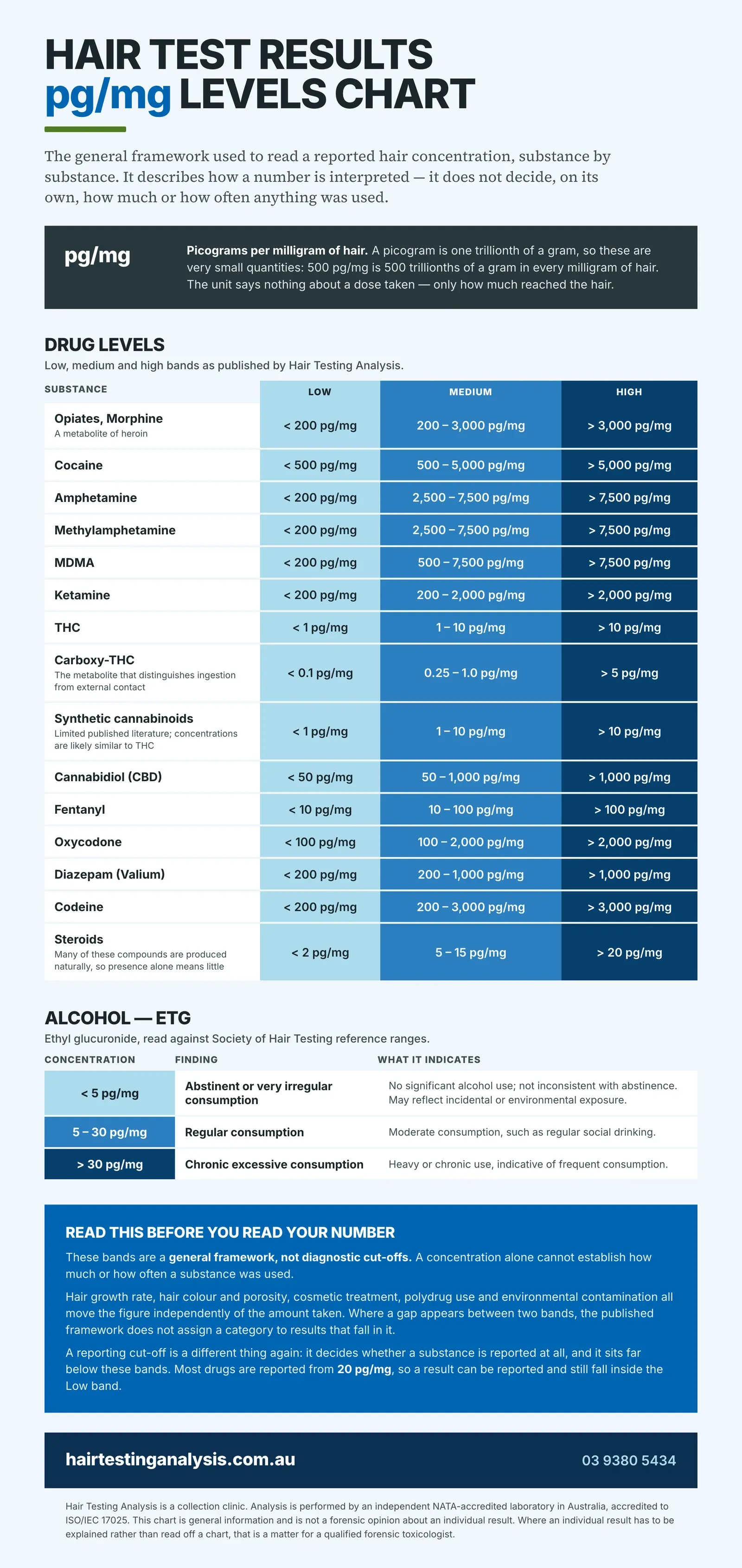
Opiates, Morphine
A metabolite of heroin
May be present alongside codeine (from codeine use) or 6-MAM (from heroin use).
| Level | Concentration | Note |
|---|---|---|
| Low | < 200 pg/mg | May be present alongside codeine (from codeine use) or 6-MAM (from heroin use). |
| Medium | 200 – 3,000 pg/mg | |
| High | > 3,000 pg/mg |
Cocaine
Can also reflect incidental contamination where no metabolites are present.
| Level | Concentration | Note |
|---|---|---|
| Low | < 500 pg/mg | Can also reflect incidental contamination where no metabolites are present. |
| Medium | 500 – 5,000 pg/mg | |
| High | > 5,000 pg/mg |
Amphetamine
The bands are the same whether it was prescribed or not.
Can also reflect incidental contamination where no metabolites are present.
| Level | Concentration | Note |
|---|---|---|
| Low | < 200 pg/mg | Can also reflect incidental contamination where no metabolites are present. |
| Medium | 2,500 – 7,500 pg/mg | |
| High | > 7,500 pg/mg |
Methylamphetamine
Can also reflect incidental contamination where no metabolites are present.
| Level | Concentration | Note |
|---|---|---|
| Low | < 200 pg/mg | Can also reflect incidental contamination where no metabolites are present. |
| Medium | 2,500 – 7,500 pg/mg | |
| High | > 7,500 pg/mg |
MDMA
Can also reflect incidental contamination where no metabolites are present.
| Level | Concentration | Note |
|---|---|---|
| Low | < 200 pg/mg | Can also reflect incidental contamination where no metabolites are present. |
| Medium | 500 – 7,500 pg/mg | |
| High | > 7,500 pg/mg |
Ketamine
Can also reflect incidental contamination where no metabolites are present.
| Level | Concentration | Note |
|---|---|---|
| Low | < 200 pg/mg | Can also reflect incidental contamination where no metabolites are present. |
| Medium | 200 – 2,000 pg/mg | |
| High | > 2,000 pg/mg |
THC
The bands are the same whether it was prescribed or not.
Can also reflect incidental contamination where no metabolites are present.
| Level | Concentration | Note |
|---|---|---|
| Low | < 1 pg/mg | Can also reflect incidental contamination where no metabolites are present. |
| Medium | 1 – 10 pg/mg | |
| High | > 10 pg/mg |
Carboxy-THC
The metabolite that distinguishes ingestion from external contact. The bands are the same whether it was prescribed or not.
| Level | Concentration |
|---|---|
| Low | < 0.1 pg/mg |
| Medium | 0.25 – 1.0 pg/mg |
| High | > 5 pg/mg |
Synthetic cannabinoids
Limited published literature; concentrations are likely similar to THC
| Level | Concentration |
|---|---|
| Low | < 1 pg/mg |
| Medium | 1 – 10 pg/mg |
| High | > 10 pg/mg |
Cannabidiol (CBD)
The bands are the same whether it was prescribed or not.
Can also reflect incidental contamination where no metabolites are present.
| Level | Concentration | Note |
|---|---|---|
| Low | < 50 pg/mg | Can also reflect incidental contamination where no metabolites are present. |
| Medium | 50 – 1,000 pg/mg | |
| High | > 1,000 pg/mg |
Fentanyl
The bands are the same whether it was prescribed or not.
Can also reflect incidental contamination where no metabolites are present.
| Level | Concentration | Note |
|---|---|---|
| Low | < 10 pg/mg | Can also reflect incidental contamination where no metabolites are present. |
| Medium | 10 – 100 pg/mg | |
| High | > 100 pg/mg |
Oxycodone
The bands are the same whether it was prescribed or not.
Can also reflect incidental contamination where no metabolites are present.
| Level | Concentration | Note |
|---|---|---|
| Low | < 100 pg/mg | Can also reflect incidental contamination where no metabolites are present. |
| Medium | 100 – 2,000 pg/mg | |
| High | > 2,000 pg/mg |
Diazepam (Valium)
The bands are the same whether it was prescribed or not.
Can also reflect incidental contamination where no metabolites are present.
| Level | Concentration | Note |
|---|---|---|
| Low | < 200 pg/mg | Can also reflect incidental contamination where no metabolites are present. |
| Medium | 200 – 1,000 pg/mg | |
| High | > 1,000 pg/mg |
Codeine
Often present alongside morphine. The bands are the same whether it was prescribed or not.
| Level | Concentration |
|---|---|
| Low | < 200 pg/mg |
| Medium | 200 – 3,000 pg/mg |
| High | > 3,000 pg/mg |
Steroids
Many of these compounds are produced naturally, so presence alone means little
Typically within the low physiological range. May reflect low endogenous production or no external exposure.
Typically seen in healthy adults, particularly males, though this varies by the specific steroid. Cortisol in healthy individuals has been reported between 1–20 pg/mg; testosterone in males commonly falls in the 5–15 pg/mg range. Age, sex, BMI, hair colour, treatment history, stress and metabolism all affect the figure.
Suggestive of elevated exposure, high endogenous output, supplementation, or external application. There is no direct correlation between dose and hair concentration.
| Level | Concentration | Note |
|---|---|---|
| Low | < 2 pg/mg | Typically within the low physiological range. May reflect low endogenous production or no external exposure. |
| Medium | 5 – 15 pg/mg | Typically seen in healthy adults, particularly males, though this varies by the specific steroid. Cortisol in healthy individuals has been reported between 1–20 pg/mg; testosterone in males commonly falls in the 5–15 pg/mg range. Age, sex, BMI, hair colour, treatment history, stress and metabolism all affect the figure. |
| High | > 20 pg/mg | Suggestive of elevated exposure, high endogenous output, supplementation, or external application. There is no direct correlation between dose and hair concentration. |
EtG (alcohol)
Bands from the Society of Hair Testing's Consensus on Alcohol Markers (2019 revision). Reading a hair alcohol result takes each band in turn.
No significant alcohol use; not inconsistent with abstinence. May reflect incidental or environmental exposure.
Moderate consumption, such as regular social drinking.
Heavy or chronic use, indicative of frequent consumption.
| Finding | Concentration | Indicates |
|---|---|---|
| Abstinent or very irregular consumption | < 5 pg/mg | No significant alcohol use; not inconsistent with abstinence. May reflect incidental or environmental exposure. |
| Regular consumption | 5 – 30 pg/mg | Moderate consumption, such as regular social drinking. |
| Chronic excessive consumption | > 30 pg/mg | Heavy or chronic use, indicative of frequent consumption. |
Why low / medium / high has limits
Eight reasons a concentration alone can mislead. These are the arguments run against hair evidence in court, worth understanding whichever side you are on.
1. Biological variability
- Hair growth rates differ between people. Faster growth dilutes concentration; slower growth concentrates it over the same period.
- Hair type and colour matter. Darker, more porous hair incorporates more drug, which can skew a result upward.
2. Environmental contamination
- Passive exposure, second-hand smoke, handling a substance, can produce detectable levels without ingestion.
- Drugs can adhere to the outside of the hair, particularly in environments where they are present.
3. Inconsistent incorporation
- Lipophilic drugs such as THC accumulate more readily than hydrophilic ones, so the same usage produces different concentrations across substances.
- Individual metabolic rates change how much of a substance reaches the hair at all.
4. Limits of sensitivity
- Where a laboratory sets its cut-off determines whether infrequent use registers at all.
- Distinguishing 'low' from 'medium' with precision is difficult for sporadic use.
5. Timeline ambiguity
- Without segmenting the sample, a single result averages months and hides periods of heavy or light use.
- A chronic user who recently stopped may still be classified as 'high'.
6. Polydrug use
- One substance may sit at 'high' while another sits at 'low', which makes a single overall classification meaningless.
7. No contextual information
- Hair analysis cannot distinguish intentional use from a prescription or accidental ingestion.
- It measures deposition, not how frequently or in what quantity a substance was consumed.
8. Legal and ethical concerns
- Simplistic categories invite unfair assumptions in legal and employment contexts.
- Courts may question a categorisation based on hair testing alone, given the variability above.
Need your results interpreted?
Dr Michael Robertson gives verbal opinions and written reports on results from any source, hair, blood, urine, saliva or breath.