
Segmental Hair Testing: Can My Original Hair Sample Stored at the Lab Be Re-Tested in 1 cm Sections?
Can your original hair sample be re-tested for drugs in 1 cm segments? How segmental analysis works, what it shows, what it costs, and when it helps.
Published · Last updated
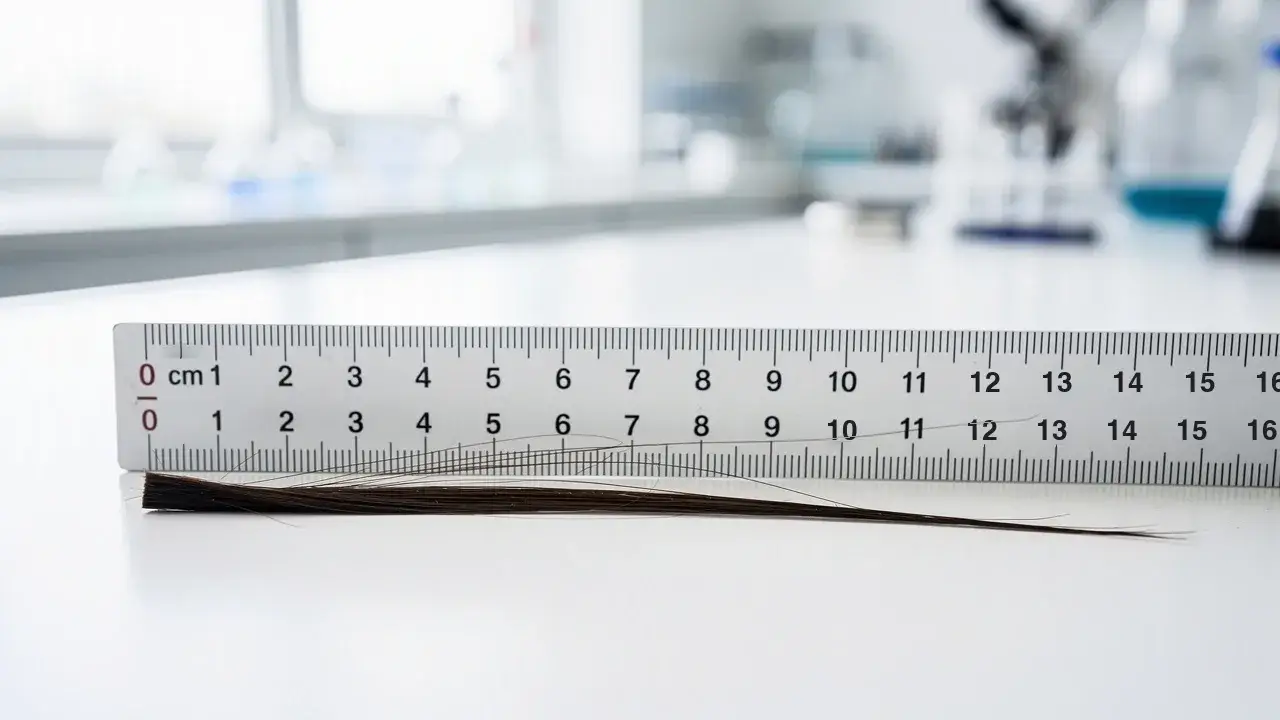
If your head hair was previously tested for drugs as a 3 cm sample, the laboratory may be able to re-analyse your stored hair in separate 1 cm or 2 cm segments. It depends on how much of the original sample remains.
If the laboratory confirms there is enough hair, you won’t need another appointment or haircut.
A standard 3 cm hair drug test gives one concentration for the whole sample, covering approximately three months of hair growth. That’s the overall picture, but it can’t show how the result varied within those months.
Segmental analysis divides the stored hair into shorter sections and analyses each one separately, so you can see how the result changed over time.
Drug testing on head hair only
Segmental testing is available for drug tests on head hair. Two kinds of sample are handled differently:
- Alcohol tests. The science behind hair alcohol testing is based on 3 cm samples. The Society of Hair Testing’s reference ranges for ethyl glucuronide (EtG), the alcohol marker, apply to 3–6 cm of hair closest to the scalp. A 1 cm segment falls outside this range, so it can’t confirm an alcohol result with scientific certainty.
- Body hair. Head hair grows continuously, so each centimetre lines up with an approximate period of time (1 cm is approximately 1 month). Body hair grows considerably slower, so a centimetre of it covers a much longer period than a centimetre of head hair. That skews the timeline. The laboratory can segment body hair, but the science can’t offer definitive answers that can be relied upon for legal purposes, so we recommend head hair wherever a month-by-month picture matters.
A segment is not an exact calendar month
Head hair grows about 1 cm a month on average, but individual growth rates vary. A 1 cm segment is an approximate period of hair growth, not a precise calendar month.
The hair closest to the scalp also doesn’t necessarily represent the immediately preceding weeks. Newly formed hair takes time to emerge above the scalp, and the exact timing depends on individual growth rates.
For this reason, segmental analysis gives a better timeline: the shorter the section of hair tested, the less the timeline is skewed. It still can’t establish the exact date of drug use, the exact date use stopped, or the amount consumed. What it does determine is the exact amount detected in each segment, reported in pg/mg: picograms of drug per milligram of hair (a picogram is one trillionth of a gram).
A result measures the concentration of a drug in the hair, not how much was taken. A small amount of a high-strength drug, for example, could show a higher result than more frequent use of a weaker one.
How segmental analysis works
Substances in the bloodstream are incorporated into the hair as it forms, and the hair then grows out from the scalp.
The laboratory aligns the hair strands with the scalp end identified and cuts them into consecutive lengths. Each segment is prepared and analysed separately, and the certificate reports the concentration of each substance detected in each segment.
The Society of Hair Testing recognises segmentation as a way of obtaining additional information about patterns of use or exposure over time, while noting that individual hair growth rates vary.
Why 1 cm does not mean exactly one month
A commonly used estimate is 1 cm of head hair growth per month. Research has shown substantial variation between individuals: one study found an average growth rate of 1.06 cm per month, with a wide range of individual growth rates.
New growth also takes approximately two weeks to emerge above the scalp, so the most recent period before collection may not be in the sample. How far back a hair test reads covers the growth window in more detail.
For example, if a 3 cm sample was collected in mid-September, the segments might be described approximately as:
| Segment | Distance from scalp | Approximate period |
|---|---|---|
| 1 | 0–1 cm | Approximately the most recent period represented by the hair, extending back roughly a month |
| 2 | 1–2 cm | Approximately the preceding month |
| 3 | 2–3 cm | Approximately the month before that |
These periods are estimates only. Hair growth varies between people and even between individual hair follicles.
Can my stored sample be re-tested?
Possibly. If the laboratory has stored enough of your original hair sample, it can be re-analysed as separate segments. The amount remaining after the original analysis varies, so the laboratory confirms there is enough before a re-test is arranged.
If there is, you don’t need another collection appointment and no more hair is cut.
How to request a segmental re-test
Every request about your results is made in writing through our contact page, using the same email address you gave us when your hair was collected. That’s how we confirm the request is really from you. We can’t reliably identify someone over the phone, so we introduced this to stop anyone else pretending to be you to reach your results. For the same reason, we don’t take results requests by phone.
- Send us a message using the email address you gave us when your hair was collected, with your certificate number and the segment lengths you’d like, for example three 1 cm segments.
- We ask the laboratory to check your stored sample and confirm there is enough hair for the requested analysis.
- You pay for each segment. Every segment is a separate analysis, and the laboratory runs the same process whether it tests 1 cm or 3 cm in one go. So testing 3 cm as three 1 cm segments is three analyses, and three times the cost. View our fees. Analysis starts once payment has cleared.
- The laboratory performs the analyses and issues a new certificate showing the result for each segment separately.
If your 3 cm was first tested as a whole, you end up with both: the 3 cm overview you already have, and a pg/mg result for each 1 cm.
If there isn’t enough stored hair, a new sample may be needed. A new sample covers a later period, because your hair has kept growing since the original collection.
If your testing is for a court or legal matter and specific dates are important, discuss the required testing period with your solicitor or forensic toxicologist before arranging a new collection.
Cost and turnaround
The laboratory charges for each analysis it performs, so each segment is priced as one test. A segmental re-test is not a free re-check of the original result. It’s additional laboratory analysis of the stored sample. Our fees are on the fees page.
Your original 3 cm test is a standalone result: one figure covering approximately three months, and it’s already paid for. Re-testing that same 3 cm as three 1 cm segments means three additional tests, so the fee is three times our usual test fee.
Results are normally issued within 5 to 7 business days once the laboratory has confirmed there is enough stored hair and payment has cleared. Because the laboratory already holds the sample, there’s no collection or transit time to add.
Plan ahead if you may need segmental analysis
If there’s any chance you’ll later need a month-by-month picture, tell us before your hair sample is collected. Planning ahead helps make sure the sample is collected and stored in a way that suits the testing you may need.
If specific dates are important to your legal case, confirm the testing period with your solicitor or our forensic toxicologist before collection, and before any decisions are made. That advice comes from them rather than your hair collector, whose job is to collect your sample correctly. Our forensic toxicologist regularly advises clients and their solicitors through the clinic. Book a consultation.
What segmental analysis can show
- A pattern over time. Differences between consecutive segments may be consistent with changes in use over the period tested.
- Different sections of the hair. Testing consecutive 1 cm segments shows whether a substance was detected in different sections of the hair.
- Less averaging. A single 3 cm result represents the sample as a whole. Segments show the differences between shorter sections, which matters when use wasn’t steady across the whole period.
When it’s particularly useful
- Showing you’re getting your life back on track. If you’ve stopped or cut down, segments can show the change between the older and newer hair, evidence of a concerted effort that a single averaged result can hide.
- If you were drugged without your knowledge. After a drink spiking or a drug-facilitated assault, segments can show no drug in the hair grown before the assault, and the drug appearing only in the hair grown after it. Tell us the date of the event when you get in touch.
What segmental analysis can’t show
- Exact dates. Segments can’t establish the exact day use stopped. They give approximate dates, because hair grows at different rates between people, and even between follicles on the same head. It’s the same reason hair needs a regular tidy-up at the hairdresser.
- How often, or how much each time. Segment concentrations can’t tell on their own exactly how often a substance was used, how much was used each time, or the precise date of use.
- A perfectly sharp change. Not every hair follicle on your head is growing at any one time. Some are resting, so a sudden change in drug use doesn’t always show as a clean break between neighbouring segments.
- Hair treatments can affect results. Bleaching, dyeing, straightening, heat and UV exposure can affect measured concentrations, and external contamination is one reason laboratory preparation and interpretation matter.
- Anything below the reporting threshold. “Not detected” means any amount present was below the laboratory’s reporting threshold, not necessarily that none was there at all. What your results mean explains how the thresholds are read. Segmental results are best read alongside the full testing history and other available evidence. For legal matters, a forensic toxicologist can explain what they can and can’t establish.
Request a segmental re-test
Send us a message using the email address you gave us when your hair was collected, with your certificate number and the segment lengths you’d like. We’ll ask the laboratory to confirm there’s enough stored hair.
If you need the segment results explained, for example for a family law or criminal matter, independent forensic toxicologist Dr Michael Robertson provides verbal opinions and written reports. See the expert medico-legal service.
Frequently asked questions
Do I need to come back in for a segmental re-test?
Usually not, provided the laboratory confirms that enough of your original hair remains. The re-test is then performed on the stored sample.
My 3 cm sample was tested as a whole. What does it cost to segment it?
Each segment is a separate laboratory analysis, so three 1 cm segments are three analyses, which is three times the cost of one test. See the fees page.
You then hold both results: the 3 cm overview you already have, and a pg/mg concentration for each 1 cm segment.
How long does the laboratory keep my sample?
The laboratory stores hair after the original analysis, but the amount remaining varies depending on the original sample and testing performed.
If you think you may need a segmental result, contact us as soon as possible so the laboratory can confirm whether enough hair remains.
Can I choose the segment lengths?
For drug testing, 1 cm or 2 cm segments may be suitable, subject to the amount of stored hair and the laboratory's requirements.
Segmentation is offered for drug testing on head hair. The laboratory can segment body hair, but the results can't be relied upon, so we recommend head hair. The science behind hair alcohol (EtG) results is based on 3 cm samples, so shorter segments can't confirm an alcohol result with scientific certainty.
Can segments prove the exact date I stopped?
No. Segments show differences across approximate periods of hair growth, so they give approximate dates, not the exact day use stopped.
What if there is not enough hair?
If there is not enough stored hair for the requested analysis, the laboratory may advise whether fewer or longer segments are possible.
If the analysis can't be performed on the stored sample, a new sample may be needed. A new sample will represent a later period, because your hair has continued to grow.
Should I plan for segmentation at my first test?
Yes, if timing may be important.
Tell us before collection if you may need a month-by-month picture or information about a particular period.
If the testing is for a legal matter, discuss the required testing period with your solicitor or forensic toxicologist before the sample is collected.
Sources
- Society of Hair Testing, 2022 Consensus on General Recommendations for Hair Testing
- Society of Hair Testing, Consensus on Alcohol Markers, Revision 2019
- LeBeau MA, Montgomery MA, Brewer JD. The role of variations in growth rate and sample collection on interpreting results of segmental analyses of hair. Forensic Science International. 2011;210:110–116.